Blending Worlds: Inside S. Donovan Croft’s Science Fantasy Epic
An interview with S. Donovan Croft about Shadows of Carath
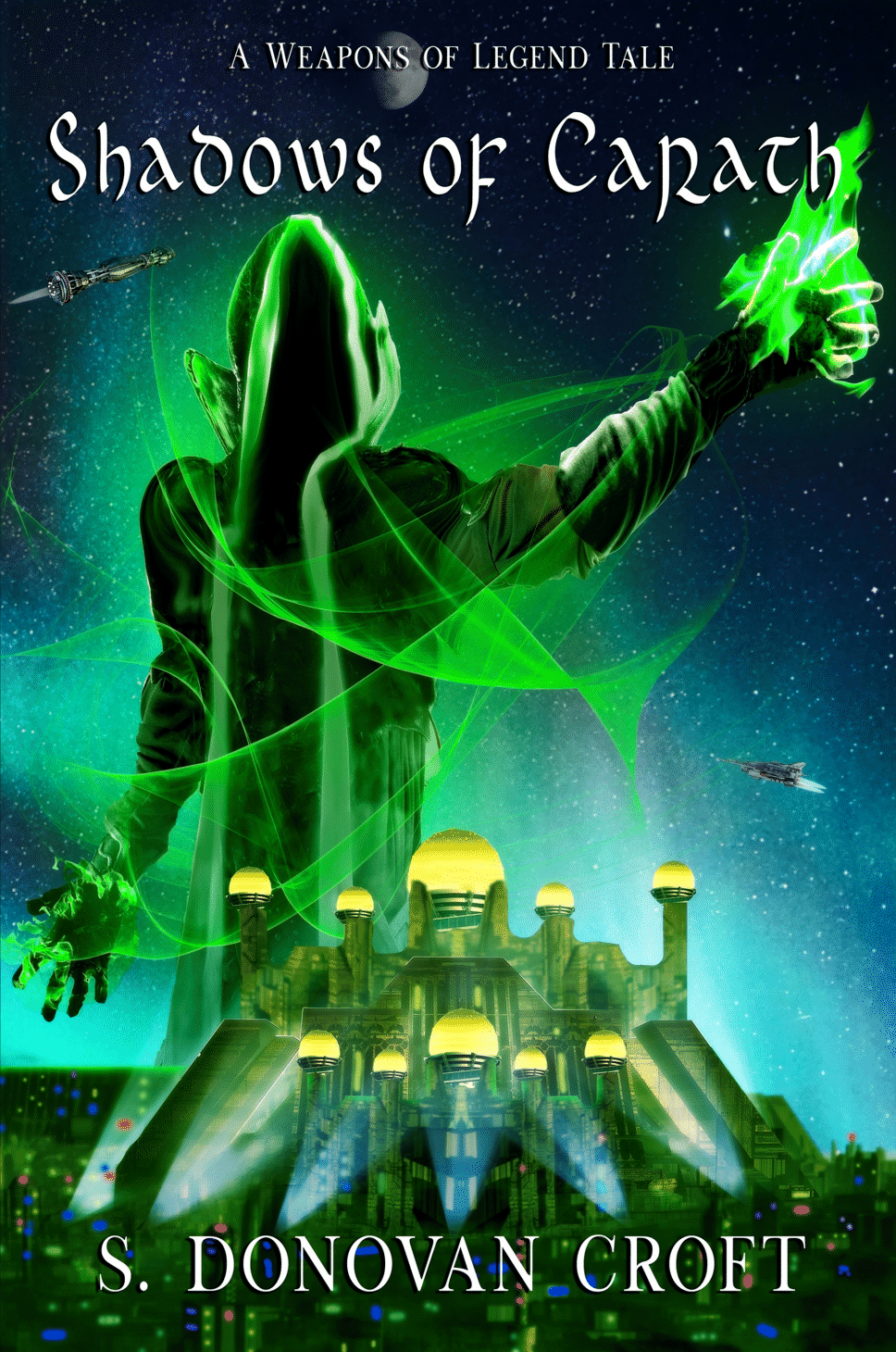
My friend S. Donovan Croft is getting his book Shadows of Carath into print. I met him at the Imaginarium in 2024, although we had been going back and forth over the internet for a while before that. You may see him in the comments under some of my posts using the name Weapons of Legend, which is his substack. You should go check it out, while it isn’t the most active there are a lot of interesting tidbits about the Weapons of Legend universe and previews of various stories.
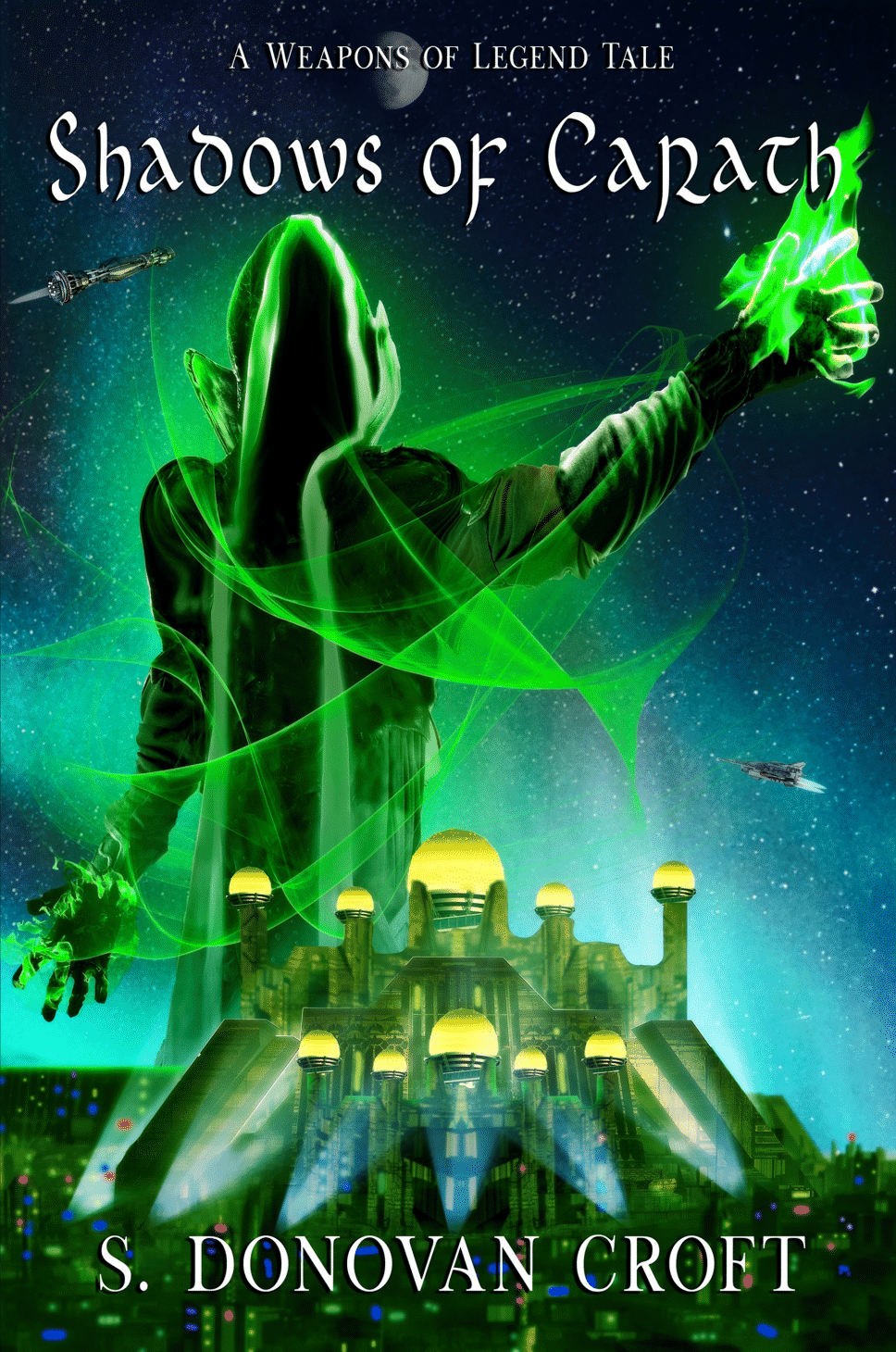
As such I put together a set of questions for Mr. Croft about his worldbuilding and Shadows of Carath.
Q: Did Shadows of Carath start as a worldbuilding project or a story? Which drove writing more in the early stages?
A: First, thank you for this interview and for giving me the opportunity to talk about Shadows of Carath. This means a lot to, and I greatly appreciate it. To answer the first part of this question, Shadows of Carath started as a story, the first in a series about a world in decline. The worldbuilding in Shadows features components like infrastructure, government, and politics, which is the stage where the story is set. More importantly, from a worldbuilding perspective, are the values, mores, and religious beliefs of the Carathian people. Now, I’ll try to keep this as spoiler-free as I can: In Shadows of Carath, the Imperial government takes actions and makes decisions that contradict those religious beliefs and values. As a result, many Carathians, even members of the nobility, experience conflict within themselves: “Do I remain loyal to Emperor Percival and the Carathian Empire, or do I stay true to my faith, values, and Carath herself?
Q: What is one piece of the world you think readers will overlook and one that you hope they can’t miss?
A: The Wrathelords, which is the order of sorcerers responsible for murdering dozens of Na’dari monks, are only featured twice in Shadows of Carath, and it’s the same individual. However, the reader will meet six Wrathelords throughout the course of the story without realizing it. And if they look closely, they may figure out who two or three are. For the second part of the question, each CISP agent uses a code number instead of his/her name. I hope the reader asks “why” because it’s a small but important piece to this plot.
Q: How did you decide what parts of the worldbuilding got center stage, and what was left behind the curtain? How much is still to be unveiled?
A: The events surrounding Bribane and Hawkins’ visit, from the annual Kathe Ball to the “Sirron terrorist” attacks, take center stage. Numerous noble families attended the ball, and the dynamics between the different Houses will play significant roles later in this series, as well as in future series. In one instance during the Ball, Lady Sonja Kobus couldn’t speak of her suspicions about her fiancé’s murder in the presence of her sister-in-law, who she “loves dearly” but doesn’t fully trust because of her former House. The details of Baron Fenris Vanat’s murder will be unveiled in a prequel novella, which will be out later next year.
Q: Did your characters shape the worldbuilding, or did the worldbuilding shape the characters?
A: My two main characters, Nico Bribane and Zachary Hawkins, are preceptors from the Na’dari Order sent to investigate the murders of dozens of monks on Carath. Both are from Galactic Alliance worlds, so there’s some culture shock that gets mitigated to an extent because their guests of Grand Duke Ashton, who was a Na’dari and their former instructor. Ashton and other Carathians, whether nobles or commoners, are shaped by their world due to over two millennia of worldwide Imperial rule. As the series continues and more rights are sacrificed for the sake of security, each Carathian’s loyalty gets tested.
Q: If there was one element of your world you could expand upon in Shadows of Carath what would it be and why?
A: The invasion of Sirronia, which takes place about eight months before the events of Shadows. In my WIP Terakaris Series, the Carathian military and their Triad allies from Arakog and Uwao are accused of thousands of war crimes by Sirrons who escaped the invasion, and the Galactic Alliance issues sanctions against them. I recently decided to feature the invasion in the “No Names” series, another WIP from this universe. Mercenaries from the Galactic Alliance assigned to evacuate embassies on Sirronia, witness some of the atrocities. One team, called the “No-Names,” intervenes on behalf of an unarmed group of Sirrons, many of them children.
Q: Was there anything the digital readers said about your world that you think new print readers should know ahead of time?
A: One of my readers compared Shadows of Carath to Star Wars, which was a huge compliment for me because that IP is among my favorite movies and books. In the Weapons of Legend “universe,” there are twenty-six intelligent species in the known galaxy. Carath is a human world, so there are only a few non-human aliens in Shadows of Carath. Among them were Chairman Inma and Commander Soli of Uwao, who attended the Kathe Ball. Both are Isurids, a bipedal, water-inhabiting species that evolved from sharks. To survive out of water, Isurids wear helmets with circulating salt water. One of my readers was fascinated by the Isurids and wants to read more about them. I told him he would, because Soli commands the Tas’Kuol, which is old Uwaon for “Death Commando.” The Tas’Kuol have the most War Crimes accusations of the Sirronia invasion.
Q: Does the universe of Shadows of Carath lean more into science fiction, fantasy, or something else?
A: Both. I know it sounds like a cop-out, but I used to call Shadows of Carath and other Weapons of Legend Tales “Fantasy stories in a Science Fiction setting.” It’s an accurate statement, but Science Fantasy or Space Fantasy would be more appropriate.
Q: That is a bold claim. A good number of science fantasy worlds fall on one side or the other. Either being Sword and Sorcery in space, or having science being the magic for the magic-less. How confident are you in that balance and how did you get there: did it start out more science fiction or fantasy and then blend into the other?
A: Great question, and all of it’s true. First, as an LEO [Law Enforcement Officer], I apologize for starting my answer with questions. Why can’t it be both? If wizards and sorcerers existed four hundred years ago, why wouldn’t they exist four hundred years from now, even with advanced technology and Faster-Than-Light space travel? If demons try to corrupt mortals, would they focus on just humans on Earth, or would they go after people from one hundred worlds? Are wizards just old human guys with white beards, or can they be they also be from non-human species?
These questions are answered. While there are mostly human characters in Shadows of Carath, we meet a couple of non-human wizards and Na’dari of various species on the space station New Avalon. The sequel, due out in the summer of 2026 and tentatively titled Purge at Deathgate, will show what happens when troopers armed with laser weapons face four sorcerers.
For WIPs, one of the later Terakaris novels will show two wizards, who happen to be “old human guys with white beards,” take on a couple of hundred RSTs (Robotic Security Troopers) to give soldiers time to fall back to new defensive positions.
In a series that takes place after Terakaris, highly advanced Tari-designed cyborgs fight a horde of dead soldiers reanimated by necromancers as “walking dead.”
In a far-future series that takes place four or five generations after Shadows of Carath, thousands of those Tari-designed cyborgs attack a temple on Arakog housing hundreds of Krag sorcerers.
I won’t give away who wins the above confrontations, but I will say neither technology nor magic wins them all. And as far as my confidence with this balance of Sci-Fi and Fantasy, I’m very confident it’ll work. I think the real challenge is getting these books into readers’ hands.
How did I get here? Without a doubt, Star Wars (movies and books) was a big influence, as was Jordan’s Wheel of Time, especially for the Na’dari. But the two instances that inspired this balance of Sci-Fi and Fantasy were in David Eddings’ fantasy series, The Tamuli where huge soldiers encased in form-fitting armor suddenly appeared to help the big-bad. Long story short, the soldiers were methane-breathing aliens, and once the protagonists grasped the concept of civilizations from different worlds, a couple of well-placed flaming arrows took care of the problem.
And of course, there was this gem from Darth Vader to Imperial Admiral Motti, who claimed the Death Star was “the ultimate power in the Universe.”
Vader: “Don’t be so proud of this technological terror you’ve constructed. The ability to destroy a planet, or even a whole system, is insignificant next to the power of the Force.” Then Vader Force-choked the middle-aged officer for making a snide comment about his “sorcerous ways,” as if that proved his point. Now, I don’t make a habit of quoting people who kill younglings, but Vader proved to be right when Luke shut off his targeting computer and used the Force to fire a proton torpedo right up that “technological terror’s” exhaust port.
To answer your question on how this started. I think these stories began more as science fiction, and the first time I put anything to paper was over thirty years ago, when I was a freshman in college. I wrote about the Bongorian Kingdom, a member world of the Galactic Alliance. I remember there were black-armored knights riding hoverbikes, now called “grav-sleds,” so the Sci-Fi and Fantasy elements were always combined. In over three decades, it has evolved into this “universe” spiraling in my head with spaceships, human and non-human aliens, wizards, sorcerers, bounty hunters, mercenaries, assassins, criminal syndicates, space pirates/privateers, secret societies, various militaries, angels, and demons.
Q: Why did you choose to go with Science Fantasy for Shadows of Carath? How did digital readers react to your blend?
A: As you might have gathered from above, like George Lucas, I’m fascinated by the concept of magic and spirituality versus science and technology. One such fight takes place in Shadow of Carath’s prologue. The sequel, Purge at Deathgate, as stated above, features magic versus technology on a larger scale. I haven’t received a lot of feedback about the genre itself, just that readers enjoyed Shadows of Carath. But I will say, to avoid misunderstandings, I took advice from my editor, Stephen Zimmer, and emphasized that Shadows of Carath contains elements of Fantasy, so readers who prefer “Hard Sci-Fi” wouldn’t buy it expecting the latter.
Q: If someone was inspired to build a science fantasy world by Shadows of Carath what would be your advice to them?
A: I’d advise them that whatever worldbuilding element they’re working on, consistency is key—in everything. That’s why I have 3-ring binders for each series filled with reference materials ranging from pictures of characters to magic systems, to lists of planets with capital cities, dominant species, and forms of government. It’s a way to prevent an author from making a simple, and preventable, mistake. For example, writing the protagonist’s ship is a frigate in one book and then saying the same ship is a cruiser in a later book, or worse, a later chapter—and yes, that happens…a lot. Details are important, and some readers will pick up on the most minute inconsistencies. And yeah, on one hand, I think it’d be pretty cool if a reader cared so much for a book I wrote that they’d remember these small details. On the other hand, and this is the kicker, it would also mean I let that reader down.
Q: Is there anything else you’d like to say ahead of launch the of the print edition?
A: Thank you for this opportunity to talk about Shadows of Carath and the Weapons of Legend “universe.”
I hope everyone enjoys these books. They’re fun reads with action and some humor that take you to new worlds with a familiar ring.
The “Shadows of Carath” eBook is available at https://books2read.com/u/3n9KaB,
The printed version of “Shadows of Carath” will be available October 15, 2025—exactly four hundred years before the story takes place!
[Book is out: On Amazon]
Day Zero: Catalyst is available at https://books2read.com/u/3nLWa5.
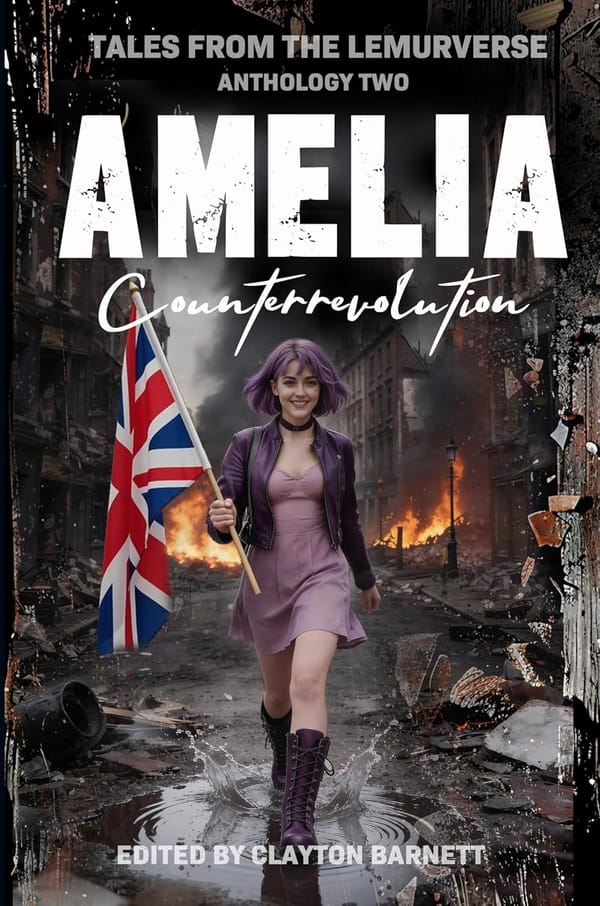
You can also find other Weapons of Legend tales along with other great stories by amazing writers in Quanta Publishing’s Sci-Fi/Fantasy anthologies “Stranded,” “Amazing Robots,” and “Noblesse Oblige Stellaris,” edited by Page Zaplendam, the Lemur Thone’s Sci-Fi/Fantasy anthology “Tales from the Lemurverse: In the Midst of a River,” edited by Clayton Barnett and Seventh Star Press’ “Marathonium Anthology, Volume Two,” Edited by Stephen Zimmer, which are available on Amazon and other fine book stores!
I’m currently working on another story for Seventh Star Press’ Marathonium Anthology, Volume Three,” edited by Stephen Zimmer. The sequel to “Shadows of Carath,” tentatively named “Purge at Deathgate,” is due in the summer of 2026.
Thanks for reading the first interview in the Gazette’s history, and a big thank you to Mr. Croft for agreeing to be the pioneer. Let me know what you think, as this is unexplored territory. If you’re excited to finally get your hands on his book, I know I am, give him a shout-out.