New Platform, new format, new titles.
Worldbuild Wednesday #0
Welcome to the relaunch of Worldbuild Wednesday, a weekly project that I’ve posted in various places around the internet. For those of you who have followed it before I am not planning on archiving or reposing the old content here. As this will hopefully be a new longer and more complete format. Thus we can leave that as a scavenger hunt for those inclined. Regardless as this is a reboot and as such we are starting at the beginning.
Thus what is worldbuilding? And how can it help you? Worldbuilding in short is a tool a story teller can use to increase the verisimilitude of the story. For those without a dictionary verisimilitude is the capacity to be believed in. In essence worldbuliding is a tool to help a story teller increase the total amount of buy in you can get from the audience. Now what you do with this increased ceiling of belief is up to you. One could decide to expand on the themes, touch a complicated subject, or slip in some rule of cool without breaking the otherwise serious story.
This connects with what I call the cooperative story. A frame work where instead of fighting the audience to have them suspend disbelief and not break that disbelief, the story teller works to build a story with the audience that the audience can believe. This changes from what could be seen as a confrontational relationship to one that is more cooperative. Although I will leave that philosophy lesson for a later date.
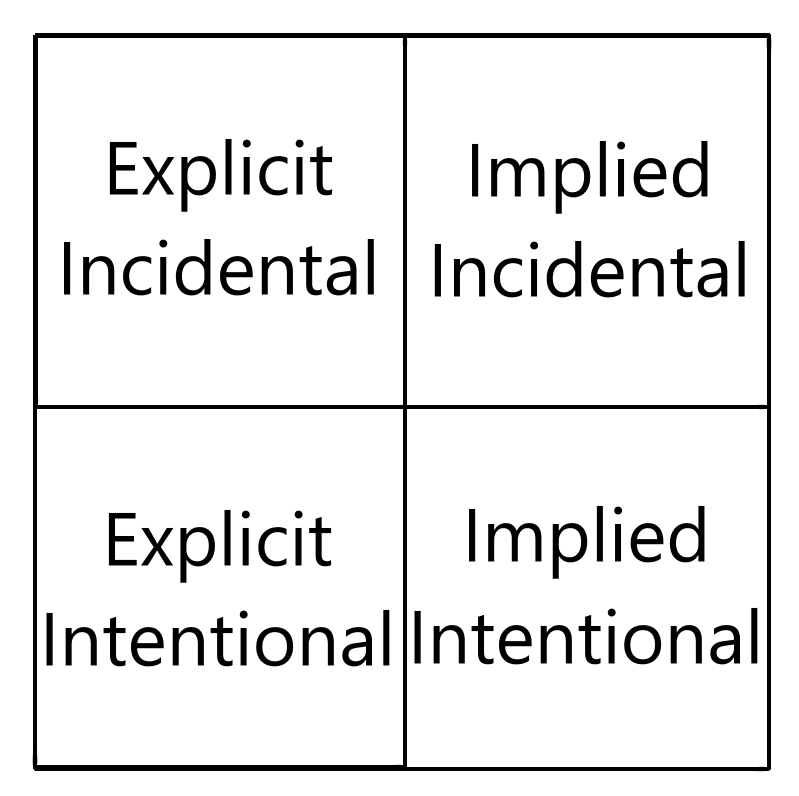
Tangent aside I see a two by two Punnett square for the types of worldbuilding. On the top there is Explicit and Implied on the side there is Incidental and Intentional.
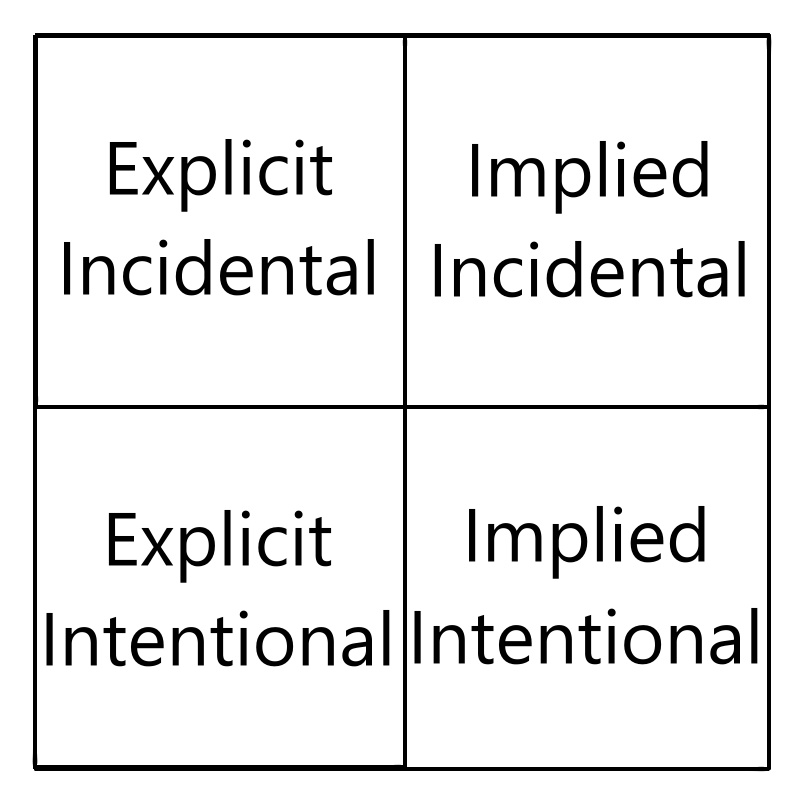
Using this chart the vast majority of worldbuilding I see is in the Implied half, and I suspect it’s in the Incidental half as well. Meaning Implied Incidental is our common quadrant. Meanwhile I, and you should you choose to join me, live in the Explicit Intentional quadrant. Lets go over the different quadrants.
Explicit Incidental is when the story teller creates something and uses it explicitly without thinking it though. A great example comes from J.K. Rowling’s Harry Potter: the Ministry of Magic. At face value it is clear what Rowling was going for a magical equivalent of the British government likely in parody of the real British government. If we take a magnifying glass to the name at first, Ministry of Magic implies it’s a portion of the British government. For the first four books it’s implied to be completely separate which is a bit of a contradiction. In the fifth there is a bit of a concession that they might be connected. Finally explicitly in the start of Half-Blood Prince. Thus while an explicit bit of worldbuilding it doesn’t appear to be intentional until almost a decade into the writing of story. There are other more instances that weren’t caught and addressed in primary or secondary media, but I should be moving on.
Implied Incidental can be seen in pop culture with the question: If there’s ice-cream in Zootopia who is getting milked? The internet decided on: It’s plant milk. Now that answer may or may not be satisfactory. Yes, the answer is irrelevant to the story. As the ice-cream shop is simply a step in the con the foxes are running. Which is all it needs to be. Yet the worldbuilders will ponder answers. If you mention a ship held the Royal Ruby Ribbon without explaining what it is. There is probably a good story behind the Royal Ruby Ribbon and the ships competing for it. Yet it was just a throw away bit of dialog to help flesh out the world.
Moving down into the intentional bracket you get the Implied Intentional square. I haven’t found a good reference in popular culture. Let me know if you’ve found one. To create an example one would need to know they will need something, say a neighboring nation who is going to play a part in the third book, but this is book one. Thus one would sketch out on a napkin the themes this nation is going to contain and get on with writing the first book. Though out the book imply and highlight these themes. Let’s say they are supposed to be militaristic and paranoid. Thus there may be some jokes about the ‘secret’ police. One could reframe the cold war story from Reagan about freedom of speech in these United States and the Soviet Union. Doing that and allowing for an unreliable narrator, gives one space to expand and explore the neighboring nation. Will build out the world though implied context.
Lastly we will come to the Explicit Intentional. This is when one sits down and builds out the world before using it within the story. Think of it like building out the stage and using it. Tolkien and Lewis make great examples. Tolkien is the better worldbuilder however as someone who has read a bit of Tolkien he uses his worldbuliding rather poorly. Often breaking the flow of the story to highlight a bit of worldbuilding. Lewis on the other hand shelves the worldbuilding for the story. Thus leading to the advice build like Tolkien write like Lewis. This will be something I will cover in detail with the Grathew’s Guide podcast. To summarize it here, after create the world and use it, within the story to progress the story. An example would be creating a corporation that has a jingle, reference the jingle as a joke or to show a connection between characters. Use that same corporation as an indicator of the failing stock market. Then show that they were in the pocket of the BBEG the entire time. Is this good foreshadowing, yes. Now when one writes the second book and the same corporation is used in the background, because it still exists and is in the world. I will admit it isn’t the best example, that comes from the complexity of proper usage of the worldbuild.
With this overview completed I hope you all are looking forward to the return of Worldbuild Wednesday, see you all next week.
Grathew