
Food to the People: A Guide to Distribution
Worldbuild Wednesday ep. 33
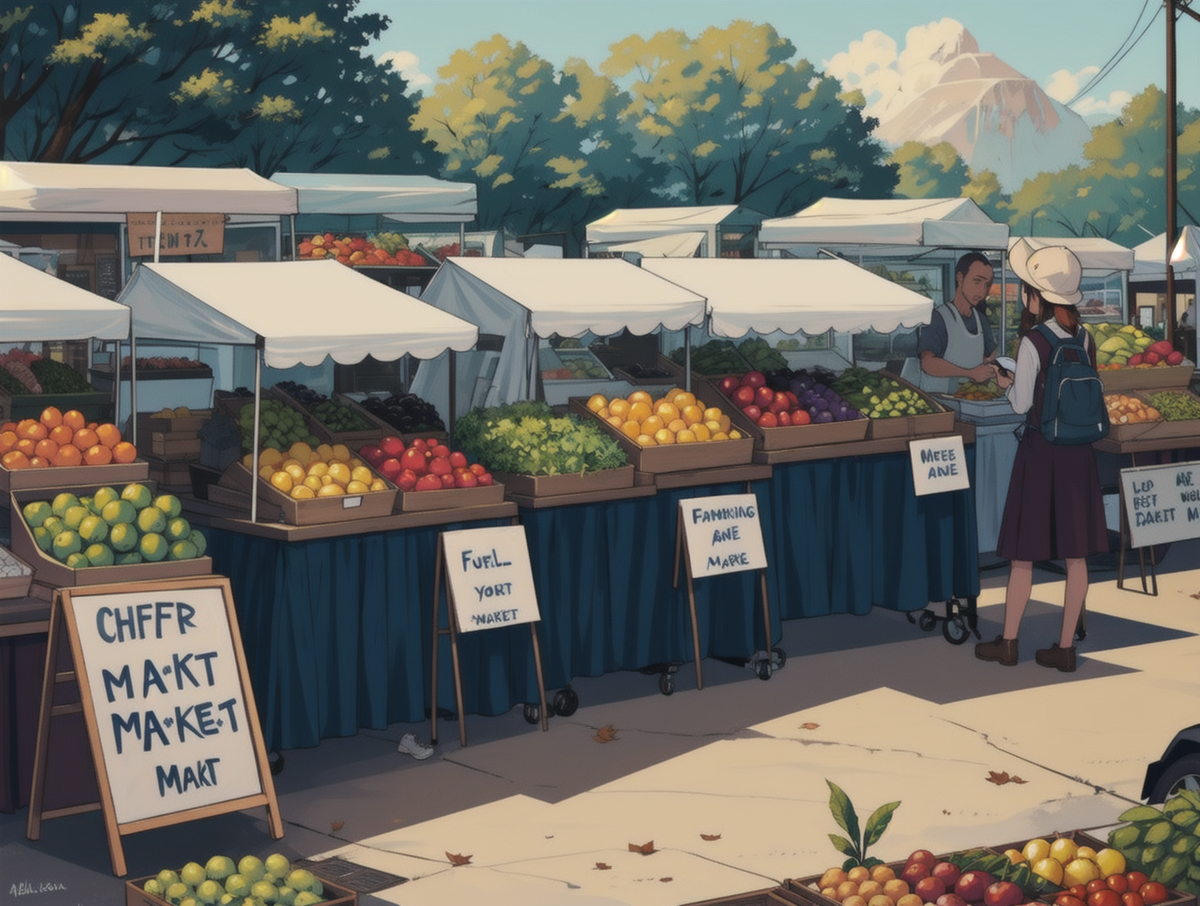
Now that we have grown the food, how do we get it out to the people? Much like agriculture, the different systems can either shape or reveal parts of the culture, change how characters view food, and possibly alter the course of the story. Thus this week I will go over how these things can affect, either as a modification to agriculture or on their own.
Firstly distribution can modify the culture’s view of agriculture either by bringing it forward in the culture’s mind or pushing it out of it. The easiest way to think about this is where do the majority of people get their food from? If it is the fields, or the farmers themselves than agriculture is likely to be relevant to a majority of the people. On the other hand if drones deliver pre-packaged, pre-measured, meal sets directly into your kitchen does it matter where the food comes from? Thus figuring out the amount of exposure to agriculture the food distribution allows is important. Generally speaking there are two main levers within this exposure bucket, distance and distribution type.
Distance is the easier of the two to understand, the farther the farm is from the bulk of the people the less aware of it they will be. If the nearest farm field is an orbit away as you live on a space station a degree of detachment is to be expected, especially when compared to the family who grows their own potatoes. If one travels by farm fields on their way to work they are more likely to be aware of agriculture even if it doesn’t directly impact their day to day life. The converse is also true, if one is stuck in a city, and never leaves it, the concept of agriculture may become more academic than reality.
Distribution type is less obvious, and more complicated. If the average person needs to go and get their groceries from the farm, their connection to farming will be greater than if it gets delivered on a regular interval. Yet if one goes to a store or market place to buy groceries, is it a company or guild that sells the foodstuffs or is it the farmers? If there is a middle man that adds to the separation between consumer and producer. Also asking who is that middle man is important as well, for they may be the organization that replaces the farmer as food provider in the culture’s mind.
These two are by no means connected, one can take the train though the farm fields and have drones deliver all their groceries to their house every Thursday at 5:15pm, and as such have only a slight idea of how they are connected. On the converse a man may buy their food from the local farmer’s market when the farmers travel into the walls every weekend, and is very aware of how farming impacts his meals.
Yet both of these assume a singular food source, and it is never that simple. After a certain point technology allows for farmers to be very remote to the consumer. I can buy apples all year round as they are in season somewhere on the planet. When multiple sources each one has to be thought about semi-independently. For example, if there are wheat fields, and pastures, surrounding a city the city may be more connected to the bread and beef that it consumes. However the fruit that it consumes is brought in via barge from up river, disconnecting fruit from the city’s culture. This wouldn’t rule fruit out as irreverent, it could be seen as exotic.
Exotic foodstuffs often are very disconnected from the culture and the location, yet become culturally important. Think of the tomato which was native to the New World, has found as much, if not more, of a home in Italian food as it has in any dish from the Americas. The same can be said for chocolate, as the arguments between German, Belgian, Swiss, and Dutch chocolate makers rages on to this day. Both of these, and my other foods, were simply not available or were very expensive due to travel distances. Which means there is a possibility for exotic foodstuffs to elevate either the growers, distributors, or importers into forefront of the culture. At the same time this needs to be balanced with the rarity of the foodstuffs. Generally for an exotic to take on cultural significant the distribution must be wide enough, and consumption common enough, that it can become apart of the culture.
The issue is with most of these worlds the levers are limited in their traverse. For example there isn’t an easy way to bring the farm to the residents of Megalopolis One. On the flip side in an agrarian culture there is going to be very few ways to gain that distance. If everything comes into the mining colony though the colony’s operator the odds of there being anyone who had anything to do with the starting end of the food interacting with the miners is slim to none. Conversely if everything has to be carried on foot the contact to the person who produced it will be much more likely, perhaps to the point where avoiding them becomes impossible.
Yet I don’t believe there is a mandated connection between the two. The way the two get intertwined changes with politics and culture. Like most things worldbuilding it is a bidirectional flow. A culture that revolves around a centralized authority may have that authority distribute the food, meaning that while your neighbor grew the vegetables you are eating it was passed though the centralized authority. Likewise if a centralized authority is too slow the people may work around it rather than with it to make sure everyone can eat.
As such when thinking about how the food gets from field to table, or perhaps pantry, doing it in stages is perhaps the best way to do it. Start with how it was done the period before, evolve into today. I know the evolution though history is one of the things I repeat fairly often, yet knowing how the time before worked is a very important part of understanding how today is. While this is true for everything, I think the distribution of food has a stronger case to be built with history in mind.
Like most systems it will take time to get established and then developed, with various forks in the road directing it one way or another. To postulate: what if we went from the more centralized large grocery stores of today to many more smaller stores within a 10 minute walk of every house in America? For my over seas readers, I know many of you have this most of my readers are in those United States thus the opposite: What if it now had to be a car or train trek to get groceries? How would that change the ideas around food? How would that change the culture of food? What would stay the same, what would change? With that in mind, add automation; everywhere. Robotic delivery trucks, robotic shelf stockers, robotic delivery to the kitchen, if there’s something that needs doing have a robot do it. That’s going to be a very different world, likely with a very different culture around food.
In the first change for America: I think there would be more of a connection to food. Right now with the distribution of grocery stores it’s possible to end up quite a ways from one, meaning fast food may be a more convenient option. With easier access to groceries cooking may replace that, as wistful thinking as that may be, and thus the culture around food may become more connected. The inverse will be happening to our over seas friends. As groceries become more inconvenient. When the robotic overlords decided to take over grocery stores things will get interesting. I would presume that as robots don’t get paid, they would lower the prices and as such make cooking cheaper. Yet I think buying from a human may become a status symbol meaning that there could be a divide from those who can only afford to buy at the robot run stores and those who can afford to buy from a human. This of course is ignoring any of the changes that could take place with cooking itself, that’s for next week.
Now those are some reasonable changes that are on the mild end of the influence scale. For a more extreme one may have to think more, extended. Either the age of sail vessels, similarly long missions in space, or the corporate run mining colony I mentioned earlier. If when the people get to the food, or the food gets to the people there is now access to things such as fresh fruit, fresh bread, and anything else that doesn’t store long term The arrival of the food may become culturally relevant. I imagine on the mining colony when the quarterly food freighter docks up there is a mini-festival when people partake in the more luxurious items, such as apples. Perhaps an outlier; yet one that may need thinking about. Especially for those of us who frequent dystopian worlds, outside of that specific case I suspect there won’t be as many cases.
Interesting exception aside; food distribution is one of the interesting things that connects the world together yet is seldom ever relevant to a story. One of those background bits of worldbuilding that should be possible to derive from the story, and how characters interact but not one that often ends up on stage, let alone in the lime light.
With that we will move on to perhaps the second most important part of the food ecosystem: Perpetration.
I know this week’s topic is a bit out there. This has been a pet topic of mine since I was a kid reading Harry Potter and wondering how on Earth food got to Hogwarts. Trust me, once you start looking for this, or evidence of this, a lot of settings crumble under their own weight. If you like this degree of minor detail dives subscribe. I have plenty more in store. If you want to go for the more story relevant stuff come back next week.