Of Humans Reptuuls and God
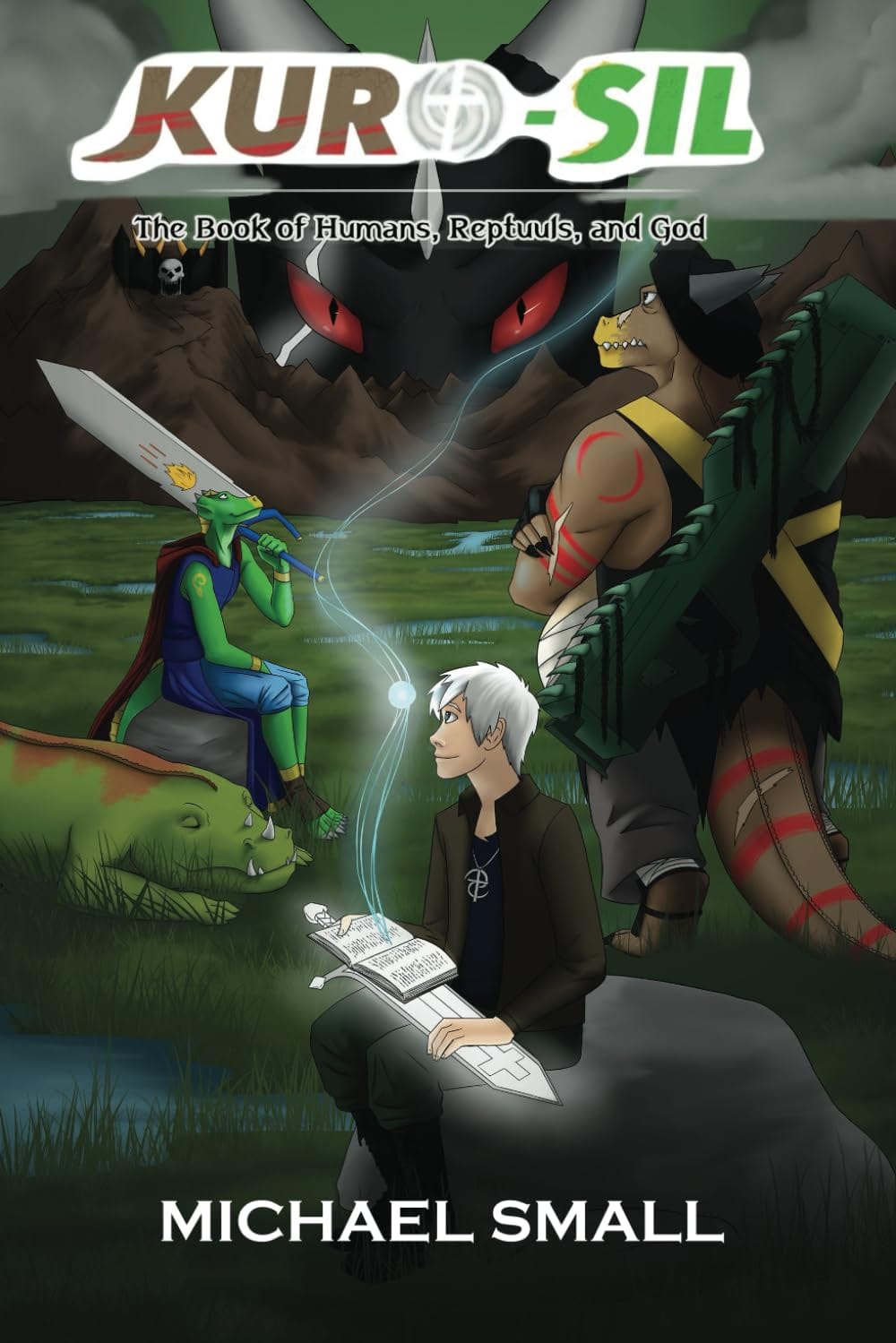
Hello everyone. Today I have an interview with Michael Small on his first book Kuro-Sil: The Book of Humans, Reptuuls and God. Michel is well on his way though his second book Rebels of Kuro-Sil. I met with Michael at the Imagnairium both times I was there, he is a lovely man with a very interesting book.
If you want to get updates on Rebels of Kuro-Sil you can subscribe to his substack with the button. It has a preview of Rebels of Kuro-Sil and should be getting updates soon.
With that said I hope you are ready for a rather insightful interview, as always we start from the bank:
Q: Did Kuro-Sil start as a worldbuilding project or a story? Which drove writing more in the early stages?
A: My series Kuro-Sil started as an idea, and that idea is a story of a boy befriending a brutish, beastly reptilian alien. It was based on a childhood fantasy of mine. I always love aliens and monsters, and just wanted to be around them, so I always imagined stories where they would exist and I could go on adventures with them. That idea was something that always stuck with me, for better or worse, and I just fantasized this idea of a big Star Wars type story with a strong emphasis on a heartfelt familial relationship between a boy and a beast. To be honest, I didn’t do a whole lot of writing when this idea came to my head. It just started as ideas of big battles and character moments. It wasn’t until I decided to start writing an outline in late 2015 that this story started to take shape. Granted, the story as it is now barely resembles that first outline, but what drove me was trying to piece together the ideas in my head into a coherent story and see if I could create something, since I wasn’t much of a creative back then, though I always wanted to be.
Q: How did you decide what parts of the worldbuilding got center stage, and what was left behind the curtain? How much is still to be unveiled?
A: First off, the central piece of my story is my characters and their relationships with each other. Good characters are truly the glue that keeps people coming back, and I’m proud of the characters I’ve created. Aside from that, what I see is a major piece of my worldbuilding is the aliens known as the Reptuuls. I am having tons of fun creating history, society, powers, etc. for these creatures. They are to me what the elves and hobbits were to Tolkien. There is plenty of lore to reveal and mysteries to unravel as the series goes on. I can’t go into much, as my next book won’t be published when this Q & A does, but there are plenty stuff brought up, such as Orren’s and his father’s past, and the mysteries of the Reptuuls religions and supernatural powers, and so on. So look out for that.
Q: As you've invoked Tolkien, does this mean that you've gone and built the world, language, culture and nations of the Reptuul before you started the story, or did you take the more modern route and get a baseline then fill it in when you were writing?
A: I was taking a more modern route and building the world as I write it. I would have loved to create a full world before writing the story of Kuro-Sil. I wanted to prove my story had depth to it before I actually wrote the plot, since I didn’t study writing in school. I did attempt to do that at first by writing an outline over the course of three years, and then I tried crafting the lore and world for a few weeks in 2019. But I decided against that because I could have spent the rest of my life crafting this world, and not actually built up the story or characters, who are the central focus of my story. So I changed course and build the world as I go along. That may not be the most ideal thing to do, but my characters are the soul of my story, and I wanted to write about them more than anything. I do have lore for my story planned, and it will be revealed as the story goes along.
Q: What parts did you decide were the important parts? How did you come to those decisions? Was it trying to backstop the parts you knew you were going to reference, or was it wanting to add enough depth to the background to move it from stetting to world? Or in a less long winded way: How did you go about building up the world?
A: The important parts at first are the Reptuul empire, their war with humanity, and their supernatural power, and built it from there. I chose that stuff to be the stuff that is already known, or perceived, about the Reptuuls, and reveal a deeper world and culture as the story goes along. At least, what is pertinent to the current chapter. The story takes place from the perspective of Orren, who is a young boy who is learning of history of the Reptuuls alongside the reader, so we get to see a deeper world unfold as the adventure moves along. Kind of similar to Harry Potter and how we learned about the wizard world alongside him.
Q: If we are to figure out the world with the character did you run into, what I call, the normality gap? From what it sounds like Orren would know things about the Reptuul, and the history between them and humanity that we can't know. How did you bridge that gap?
A: The answer is simple: Orren actually grew up with his birth family on a planet only populated with humans, and will be taken by Reptuuls to their planet and learn more about them on his journey. He has been fascinated by Reptuuls his whole life due to stories key friends told him and strange dreams of being saved by a Reptuul when he was an infant, and despite humans being forbidden from interacting with Reptuuls, Orren is determined to befriend them and end the war his own way. Think of his upbringing like that of Harry Potter under the Dursleys and how they refused to tell him he was a wizard. So we will learn about the Reptuuls alongside Orren.
Q: Does this mean that we will see the Reptuuls from different angles as different people in the story have different experiences with the Reptuuls? Will the Reptuuls also have varied views on Humanity?
A: Don't worry, we'll see plenty of things from the Reptuul's perspective. For example, the characters Kor'Ba and Ti'Ran have completely different viewpoints. Ti'Ran is more optimistic and noble, is always eager to save humanity, and acts like a loving big brother to Orren, while Kor'Ba is more pessimistic and grumpy. However, while he acts like he wants nothing to do with the war between humans and Reptuuls and Orren, he secretly does care a lot about both, and will always come to save Orren when he's in trouble, becoming sort of a father/brother figure to him. There are a handful of other Reptuuls throughout the story, both good and bad, and they all have differing views on humans, such as a pleasant older Reptuul politician named Gresh who is secretly aiding the rebel force called Kolos, and there are the villain group the Garathal, the leader of which named Krull thinks humans are beneath him and takes pleasure in enslaving them. While the majority of the story takes place from Orren's perspective, since Kor'Ba and Ti'Ran are almost always at his side, there are a few sections from their viewpoint, and I have plans of retelling the beginning of my upcoming story from Kor'Ba's view.
Q: With such a diverse cast how do balance the different perspectives? Did you find you needed to build around the cast before or after you came up with their prespectives?
A: It is hard balancing a large and diverse cast of characters. The way I do it is by giving the focus on my most important ones first and foremost. My main characters are Orren in the lead role, followed by Kor’Ba, Ti’Ran, and their pet Burk. I ensure that these four are central to my entire plot starting off. As for my side characters like the ones named Kedrik and Nalari, I introduce characters like them slowly throughout the course of my first main book to assist my main heroes, and plan to give their backstories in later books, so that the focus won’t be drawn all over the place. The interesting thing for me is that I wrote the book “Kuro-Sil: The Book of Humans, Reptuuls, and God”, which wasn’t planned at first, but I was inexperienced in writing large casts of characters, so I wrote that book as a smaller scale adventure where the central four are the in the spotlight at all times. That way I could improve my writing skills, and understand their dynamics before I wrote the larger cast as a whole. I also have ideas of writing spinoff stories focusing on other important characters, such as the older brothers of two of my main heroes, but those won’t happen for a while. There was stuff that was planned, and stuff that came as I developed my world. It’s all in how you craft your writing.
Q: Large casts make for interesting worlds, and tricky stories. As there's many things to balance in one book, and many more threads to pull from with those side stories and sequels. What do you think was the most important lesson you learned with this cast of characters in the world you built?
A: Now I'm still an amateur writer, so I probably may be too ambitious with the size of my cast. That's the reason I wrote my other book "The Book of Humans, Reptuuls, and God" first, because my first attempt at my first book took too long to bring my heroes together, so I wrote a smaller story with only my main heroes when they already knew each other before I wrote the larger cast (I may have already said that in a previous question, I can't remember). However, what I learned in balancing them is finding out who my characters are, and figuring out who is relevant to whatever scene. I have a hierarchy of who's important to my story, with my heroes Orren, Kor'Ba, Ti'Ran, and Burk at the top, and their other friends below them, so as I write each chapter, I figure out who is teamed with who, what their quirks are, and how they cooperate with each other. My first main book focuses on my main four heroes, with each of their other friends getting more backstory development in subsequent books. My story is written in an episodic manner, so the chapters are presented like tv episodes, in my mind. It's kind of like a puzzle I'm trying to figure out how to put together. So it was all in learning about my characters, because I think characters are the cornerstone of the best stories.
Q: That is a very good lesson to share. Is there anything else you'd like to say before we sign off?
A: All I can say is I never thought I could be a writer, but I took a risk, taught myself how to write (not that I was illiterate, I just improved my craft), and told the story I've longed to see. I hope others, if they have had some story or creative idea in their head for a long time, then just write it out. It doesn't have to be something you have to sell, just try it. Creativity is what humanity uses to create societies. They teach us how to live and inspire us to be better. You may think you don't have what it takes, but you never will know unless you try. That's what I did.
I'd like to thank Michael for the interview. Kuro-Sil is a world I am looking forward to seeing get more from it. It is not very often when I find a single book that gives a good window into a whole world.
With that I can say I recommend Kuro-Sil you can find it on Amazon helpfully linked in the button below.
I would also like to think you for reading this interview, I hope you found it interesting and I will see you in the next one.